
MUSICA - 凛として時雨 / Dec 2025 interview

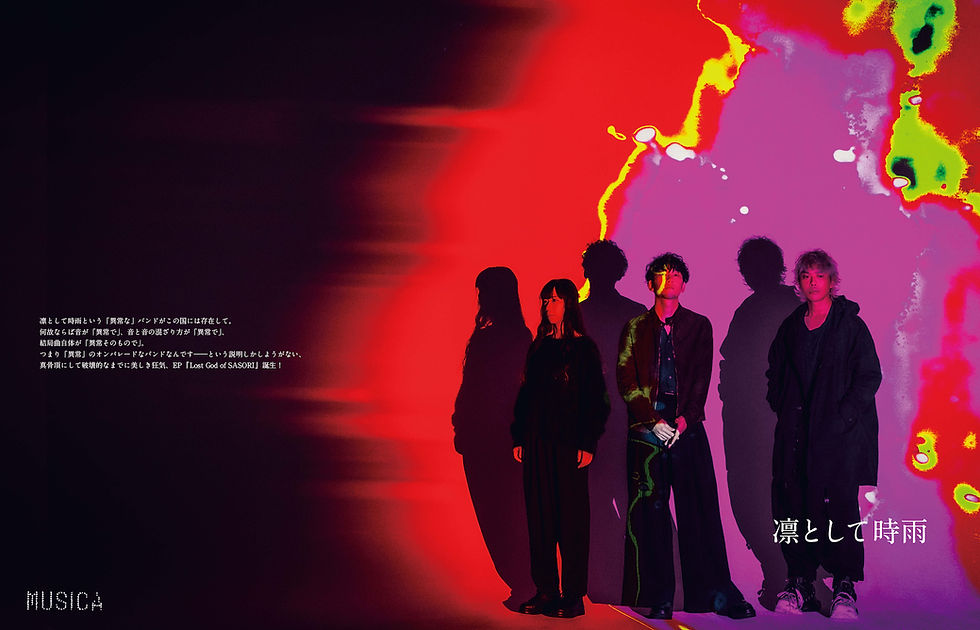
Ling tosite sigure is an “abnormal” band that exists in this country.
The sound is “abnormal”
the way the sounds blend is “abnormal”
and ultimately the songs themselves are “abnormal at their very core.”
In other words, they’re a band that’s a full-on parade of “abnormality” there’s really no other way to put it.
Their true essence — a destructive yet overwhelmingly beautiful madness — is embodied in the EP “Lost God of SASORI.”
It’s not that a special band made a special EP because they are special, they made an EP that is even more special than the band itself.
An EP so extraordinary that in just three lines, the word “special” is used five times: that is“Lost God of SASORI.”
Distorted guitars and sharply angled, twisted rhythms sometimes evoke silence, sometimes the edge of madness.
TK’s voice, singing, murmuring, screaming, descends like the roar of a soul wandering through the void, through a place where closing your eyes does not erase the light, where opening them does not escape the darkness, where no matter what you shout, “it won’t reach,” yet you can still hear your own voice.
The EP contains four tracks plus a bonus track, each one proving Ling tosite sigure’s extreme musicality, while leaving completely different resonances in the listener’s mind. It’s not the first time one has wondered why a band like this exists, or how sound alone, just the intertwining of notes can evoke the feeling of the world turned upside down. Yet this work stands as a monstrous creation: “four tracks where Ling tosite sigure remains itself, yet surpasses itself.”
The band is preparing for a solo show at Nippon Budokan this year-end, and the reason they maintain such a market, inspiring generations and eras to dream of becoming a band like them, is that their three-piece ensemble embodies its full charm in every way. Moreover, the raw songs that form the core of that ensemble boast an unanalysable artistry.
Ling tosite sigure’s abnormal musicality is still embraced as pop because they are not simply an isolated entity; there are always those who resonate with, or try to share, their solitude. And it is precisely for this reason that they are able to transcend even the concept of Ling tosite sigure itself in a work like this EP.
▶ “At first I honestly thought all the songs were completely chaotic. In other words, creating an EP this brilliant is no easy feat. I felt it was a real critical hit. It truly is an intense, overwhelming tapestry of Sigure. I heard this EP was recorded in London…”
TK (Vo/Gt):
“Well, in terms of recording, we only tracked a few guitar parts. Basically, we went to London to write music. Earlier this year, I went there to record my solo albumWhose Blue(released in April), so thinking about it now, I actually went twice this year (laughs).
Since last year, we’ve occasionally had opportunities to borrow a songwriting studio beneath Metropolis Studios. This year, too, I wrote songs there alone for my solo album, and then BOBO joined me for the recording. That made us think: it’d be great if Sigure could also write music in London.
But when it comes to recording, the hurdles shoot up, gear, cost, everything. So I thought, what if just 345 and I go there to write? And 345 was immediately like, ‘Of course!’ So the two of us went. Part of it is just our personalities, 345 and I like going abroad, while Nakano prefers Japan.”
Pierre Nakano (Dr):
“I love Japan (laughs).”
TK:
“It’s not like Nakano doesn’t want to go overseas.”
Nakano:
“Yeah, it’s not that I don’t want to go.”
TK:
“If the three of us decide to go together, we can. It’s just that the songwriting studio we used isn’t big enough for drums, and drums require a lot of detailed retakes. So for songwriting, it’s more efficient for me to program the drums, send the files to Nakano in Japan, and exchange ideas that way. That allows the process to keep moving without interruptions.
I wasn’t sure how it would go, but songs really did come out at a pace of one per day.”
▶ “For Sigure, that’s considered very smooth?”
TK:
“It is. Why it went so smoothly… I still don’t really know (laughs). I had been making my solo material in that same room not long before, so I was even worried:What if too much of that atmosphere lingers, and the vibe ends up not being Sigure at all? But that didn’t happen.
To begin with, writing one song per day is something that almost never happens for me. Sure, there are people who can write smoothly like that, but I’m not that type. So I was like,‘Seriously?’(laughs).”
Nakano:
“‘Seriously?’ (laughs).”
▶ “Enough to make you slip into Kansai dialect, like you weren’t even yourself.”
TK:
“Exactly (laughs). If it were something minimal, like a stripped-down idea or an acoustic skeleton, that would make sense. But these were proper demos, one per day.
So in the end, I realized that what matters isn’t time, but the environment that pushes you toward making music, and though it’s a worn-out word “inspiration”.
The scenery you see, or even the view you catch while going out to buy a coffee, those things imprint on your brain more directly than you expect.
It’s not that British-music air gets absorbed into the songs, but the speed at which sounds appear in my head becomes incredibly fast, while still not overlooking the details I would normally notice… something like that.”
▶ “345, including the smooth songwriting, how did you feel about your days in London?”
345 (Vo/Ba):
“It was my first time seeing TK create songs in front of me at that pace, one per day. Watching him like that really reminded me of how we made songs in the very beginning. We weren’t writing one per day back then, but seeing how these ideas kept coming out, surprising me day after day that feeling definitely brought me back to the early days.”
▶ “And how was working in a London studio, or simply creating while feeling the London air?”
345:
“The environment was honestly fantastic.”
TK:
“But the studio is actually really small! Metropolis itself is this huge former factory, a big-name studio where mastering happens, and every day top artists work there like, ‘Ed Sheeran might drop by to check something today’ that kind of atmosphere.
Underneath it, there are rooms rented by different producers. Going down to the basement feels like descending into a prison (laughs). But once inside, it’s just a space where you have no choice but to make music.
Even though it’s underground, it strangely has windows.”
345:
“Kind of like a half-basement.”
Nakano:
“You can actually see outside through them?”
TK:
“Yeah, you can.”
▶ “And that environment worked well for you, 345?”
345:
“Yes. The studio, the walk between the hotel and studio, the surroundings when TK wanted to concentrate alone and I wandered around, everything felt calming, mentally grounding. Nothing felt rushed.”
TK:
“Yeah. Actually, I didn’t really like London at first (laughs). My sister lived in Oxford, so I often visited her, and I’d been to London for Sigure tours and family trips. But back then I felt like,‘I left Tokyo only to come somewhere even faster-paced?’
But that was just me judging the whole city based on a few areas I happened to see, just like Tokyo feels different depending on the district.
The area where the studio is, Chiswick, is a classy part of West London, full of cafés and antique shops, yet with no big tourist attractions. It’s just… comfortable.
Walking 10 minutes from the hotel was enough to refresh myself. It really suited me.
And the landscapes I saw in the UK before Sigure even started, the gray, slightly cold scenery those influenced Sigure’s sound and lyrics deeply. Not in a UK-rock sense, but in that distinctly British chilly grayness.”
▶ “The smells and the wind, right?”
TK:
“Right. Even the simple act of seeing those everyday scenes refreshes me, and I think that air really fits Sigure’s music.
345 said it reminded her of our early days, probably because lately we’ve been revising and revising our songs over and over. But this time it felt more like rushing straight through, in a good way.
That sense of release might be one of the reasons.”
▶ “I definitely felt that. Nakano, what was it like when you received those songs from London?”
Nakano:
“It honestly made me restless. Not just me, our staff too. We were all like,‘These insanely high-quality tracks are coming in at an unbelievable pace!’We were in a state of,What on earth is happening?
And hearing only now that they wrote all that in such a tiny room, I’m seriously stunned. Like,You were creating all that in those conditions!?”
▶ Were you excited as the songs arrived?
Nakano:
“Of course I was excited. But at the same time, I knew we would eventually record them, and once you play a song live it takes on a different atmosphere. I wondered how that sensation would evolve.
There was also a sense that the material placed a certain demand on me so I thought intensely about how I should respond to the sound TK was sending over, and what kind of approach I needed to take.”
▶ The feeling 345 mentioned “something reminiscent of the early days” and the overwhelming impression I had when I first heard the project, seems tied to what TK described as that “straight-ahead rush” the sense of letting intuition lead instead of deliberate refinement. This year marks 20 years since your indie debut #4. Did you intend to create a work like this as a milestone?
TK:
“No, that wasn’t on my mind at all. I didn’t try to make things align in any particular way.
Honestly, the songs were coming together so fast that part of me thought,‘Once I’m back in Japan, I might realize everything is awful and need to redo the whole thing.’
I did send the material to Nakano and the management team, but even if they felt something was off, you can’t say to someone composing alone in London, ‘Um… this feels kind of different from usual’, right? (laughs) The only thing youcansay is, ‘We’re looking forward to it.’”
▶ (laughs) Of course.
TK:
“So yes, that scenario felt entirely possible. Maybe 345 and I were simply caught up in the London air and thinking everything was brilliant, but once in Japan the impression might change. But when I returned and listened in a different environment, I thought,‘Actually… this might be fine as is.’
It’s not that I constantly think back to the#4era, but looking back now, the process was similar, except for the first track ‘Loo% Who%’, which I’d been working on earlier because of the tie-in.
The other songs came without overthinking their meaning or structure. They descended naturally, music that felt like an extension of myself.
That felt right to me. Of course, that comes with the risk that listeners might say, ‘It sounds like you didn’t polish it this time.’ But I chose not to double-check any of that.
So honestly, I still don’t know how this work is being received…
But if someone like you, who has listened to sigure for so long, tells me, ‘It’s outstanding.’ then that truly makes me happy.”
▶ It is an outstandingly wild work. Especially track 3, “sick mind B rain.” On YouTube someone commented, “Just when you think the track has gone completely mad, it suddenly turns melodic and that contrast is addictive.” I felt exactly the same. This EP sharpens the madness unique to Ling tosite sigure, and I think people who’ve followed your music deeply will feel that even more strongly.
TK:
“With ‘Loo% Who%’ as well, our long relationship with thePSYCHO-PASS series made people associate sigure with it, andTokyo Ghoul became tied to my solo work.
But this time, for a non–PSYCHO-PASS project to choose us for an ending theme, that’s… not a normal choice, right?”
▶ (laughs) Definitely not.
TK:
“So that means we’re allowed to go completely unhinged, right?”
Nakano:“Hahahahahaha!”
TK:
“For Loo% Who%’ (the ending theme forGnosia), I wanted to push beyond the usual ‘tie-in catchiness’ and aim for something where a deeper, more essential catchiness might emerge.
I wanted people to feel,‘Wait, where are we in the song now?’even though it’s a tie-in.
Of course I linked it to the anime’s themes, but I felt that beyond that, there was a kind of catchiness that exceeded people’s idea of sigure.”
▶ In June 2023 you released PSYCHO-PASS: Cutting the Digital Domination, a compilation that summarized your tie-in works for the series.
TK: “Right.”
▶ You then released “Trrrrrrrrrrrrrrrrrue Lies” for Stage PSYCHO-PASS Virtue and Vice 3, and with “Loo% Who%” you began a new collaboration with Gnosia. How did you approach that?
TK:
“As I said earlier, I felt that making it completely chaotic was the greatest respect I could show to the people who offered us the job, so I made it chaotic.”
Nakano:“Chaotic! (laughs)”
TK:
“Normally the anime side doesn’t need to approve the full version, only the TV edit.
But since the full lyrics and worldview still relate to the anime, I sent it with, ‘Let me know if there’s anything you want addressed.’
Sometimes unexpected suggestions come back.
For example, when the acoustic version of ‘unravel’ came out, another season, not even the one I was responsible for, asked, ‘Could we play just one verse of the acoustic version in our episode?’
I made a full version and sent it, and they ended up using far more of it than I’d expected.
Occasionally these small miracles happen.”
▶ Earlier 345 said that watching you create music reminded her of the early days. Did you also feel something like a return to your roots in how you approached the bass?
345:
“Yes. In Japan TK usually sends a solid demo, and I recreate the bass line or adjust it slightly.
But this time we were together in the studio the entire time, so I was reacting and playing in the moment.”
▶ Last time you said, “95% of my life is Ling tosite sigure”a legendary quote. For someone like you, was this way of working irresistible?
345:
“Yes, it was incredibly fun.”
▶ Pierre said he spent a lot of time thinking about how to approach the material you sent. How did it feel in practice?
Nakano:
“I was completely immersed, totally absorbed.
Every time a track arrived, I thought about how I should play it. And during recording the arrangements would evolve further, so I constantly had to adapt.
I really worked on it in a state of total focus.”
▶ Pierre remains a genuine fan of Ling tosite sigure, yet he faces the band with professional discipline. I find that stance very unique and admirable.
Nakano:
“Are there not many people like that?”
▶ Many musicians keep that pure “I love this band” feeling, but in your case, it’s both unconditional love and objective love. That duality is rare.
Nakano:
“Ah, I think that’s probably something I had already decided when I joined the band. And also, the fact that the other two keep updating themselves properly, that’s huge. Every time, I honestly think they’re amazing. I think that’s exactly why I’m able to stay in this position.”
▶ When we met at TOKYO ISLAND, you also spoke passionately about this release: “For this to come out at this point in our career is really incredible.”
Nakano:
“Exactly. I’ve been telling every industry person I meet, ‘The new song this time is seriously insane, please listen to it’ (laughs).”
TK & 345:
“(laughs)”
▶ In practical terms, when it comes to how you adjust yourself to that, do you feel like you’re constantly going through trial and error?
Nakano:
“Yes. I do various activities as a drummer outside the band too, so I’m always thinking about which elements I can bring into Shigure.”
▶ I see. Going back a bit—did you go to London from the beginning with the intention of making an EP?
TK:
“Yes, I planned to make an EP from the start. I had this vague feeling that it wasn’t going to be a single this time. And then I realized we haven’t actually released many EPs. Also… sometimes I feel like full albums just have too many songs (laughs).”
▶ Is that because of the times?
TK:
“No, it’s not really about the times. It’s something I’ve always felt personally (laughs). Maybe it’s unusual, but I’ve always really liked singles and EPs. Of course, fans often prefer albums, and as a creator there’s a particular pleasure in presenting a conceptual work as one solid body. But for me, the way I face each song isn’t like a course meal, it’s more like pouring everything into one track at a time. So I think singles or EPs allow listeners to receive each piece without anything being left behind. And also… maybe it’s because the information density of one song is kind of abnormal (laughs).”
▶ Then I’d like to ask about each of the four tracks. Starting with track one, “Loo% Who%.” As you mentioned earlier, this track began from the offer to create the ending theme for the TV anime Gnosia. To me, this song feels like Shigure’s methods at incredibly high purity, yet freshly updated, the rhythmic sense of the two of you, the lyrics, everything. Could you talk about this song with that in mind?
TK:
“Eh, that’s hard. I mean, you’re throwing a huge topic at me (laughs).”
345 & Nakano:
“(burst out laughing)”
▶ Yes, please treat this like a self-liner-note (laughs).
TK:
“I don’t know… but honestly, there’s nothing more inside me than what I already said. This might be the time I’ve had the least to say. It feels like something that just naturally came out of me, to the point where I’m like, ‘Wait, did I evenmakethis?’ Of course it was hard while facing it, but that’s how natural the output felt.”
▶ For example, in the lyrics, “lies” seem to be an important theme. It connects to “Trrrrrrrrrrrrrrrrrue Lies,” and there’s this sense of things being one hair apart, like <want to die> and <want to believe>, <true> and <false>. And that thin-line tension also feels very present in Shigure’s sound—the roaring volume that’s one hair away, the transitions that are one hair away, the groove that’s one hair away. This song seems to embody that vividly.
TK:
“Hmm… when it comes to words, I always think lyricists are incredible. Lyricists have so many drawers of vocabulary, they can become a completely different self each time, to the point of dissolving their own identity. I’m the total opposite. The words I can express are very limited. All I can do is catch whatever emotion appears in that moment and place it down if I manage to grasp it. So this time, I think the lyric work, the work of catching feelings and waiting for the words to fall was harder than the sound part. That’s probably because I released a full solo album earlier this year. Even if the projects are different, my brain that outputs words is still just one. It’s not like I consciously separate “solo words” and “Shigure words.” Maybe some unconscious separation happens, but I’m not doing it intentionally. So it felt like I had even less than usual, like there was nothing.
I could get to the sound part, but when it came to the words, I had to place down what I was seeing or feeling beyond pure impulse, in a visible form, letters. Unlike sound, which is invisible, written words remain as physical shapes. That difficulty felt stronger this time.”
▶ You’ve often said that when it comes to lyrics, there’s almost only one thing you can express or want to express. But I think you’ve continually proven musically that even the same “words” can create completely different pictures.
TK:
“When it comes to the music I create, I truly believe that. I don’t know many chords, and I’m not bringing in jazz or funk or anything like that, I still only have what I originally had. I’m just changing the angle little by little and continuing. Maybe that’s what appears as “updates” like Nakano said. But from my perspective, if I’m going to use the word “update” then I should be able to feel within myself that I’ve progressed compared to last time. If I had that feeling, then I could say I’ve updated myself. But I don’t really feel that. I’ve probably said this for years, but it always feels like I barely squeezed something out of myself again, and now I have zero stock left. It’s been like that for about 20 years. I don’t feel like I’m advancing and maybe I’m really not.
It’s just about whether I happened to encounter what I wanted to create at that time. Maybe since the first album, I’ve just been declining. I don’t know how listeners evaluate it, but the only work that held that kind of “primal purity” might be#4. That’s why that album remains something special I can never surpass. And by the third album I was already saying “Inspiration is DEAD” (laughs). If I said that now it’d make more sense, but I said itpretty early!”
345:
“You said itsoearly (laughs).”
TK:
“When I think about that, I guess I’ve been hanging in there (laughs).”
▶ (Laughs.) 345, could you tell us about your memories of recording “Loo% Who%,” including the session itself?
345: “That’s a tough one….”
TK: “Oh right, this time I recorded for the first time in a while ( TK acted as the recording engineer) I did almost all of it.”
345: “Ah, that’s true. We originally went to the UK with just the 1.5-minute anime version already completed.”
▶ And that’s the version included as the bonus track?
TK: “Yes.”
345:
“From there we had to decide how to turn it into a full-size track, how to finish it as a complete song and that part was really difficult. I kept wondering,what should we do…?
If I remember correctly, we worked on the other three tracks first, and this was the last one, right?”
TK:
“Right. I wanted to start with the ‘zero-to-one’ songs first. If I got too addicted with expanding the 1.5-minute version, I’d end up being able to work on nothing else and then I’d have no face to show management (laughs).”
▶ Even though you went all the way to London.
TK: “Exactly (laughs). So we first tackled the new songs from scratch, and those went surprisingly smoothly. Once I felt confident about that, I thought, Okay, then I can handle turning “Loo% Who%” into a full version, and we worked on it last.”
345:
“Even then, it was still difficult. I don’t remember clearly, but at one point when we were stuck, I said something like,‘No, this needs a guitar solo!’And then TK immediately came back with this insanely cool guitar solo. I was like,of course he did.That left a strong impression on me.”
▶ That’s some real chemical reaction. How about you, Pierre?
Nakano:
“After the two of them returned (from London), we started the recording. In our case, the arrangement keeps changing as we record, so I’m basically playing without really knowing what the finished shape of the song will be—I just play intensely in the moment.”
TK:
“Especially this time, we were practically recording while still in the pre-production stage. So there really wasn’t a typical pre-production process. Of course, for ‘Loo% Who%,’ wehadto submit the 1.5-minute version first, so we recorded that earlier.
Which means: the bonus track (the 1.5-minute version) is a completely different take from the full-size version.
Excellent bands record the full version first and then cut out the 1.5-minute edit. But in our case, we pour our souls into the 1.5-minute version first (laughs).”
▶ Is that the usual method for TK and the band?
TK:
“It depends—sometimes we do it the other way.
But recently, anime deadlines come extremely early. Even if the anime airs a year later, they often say, ‘Just give us the 1.5-minute version now, even a demo is fine.’
So we end up recording that much first even when the full song isn’t finished yet.
Personally, I prefer making the 1.5-minute versionas its own complete formrather than cutting it from the full track.”
▶ Let’s return to Pierre.
Nakano: (laughs)
“With this song and honestly with every song. I’m basically playing without understanding the whole structure. I pour all my attention into how to make the phrase in front of me sound cool. Then they take that material and complete the song with it.
So my focus is on how high I can raise the quality of those recorded performances.”
TK:
To add one thing: when everything is already decided, it’s faster to ask an engineer to record the set phrases quickly.
But when Nakano is still chasing the overall shape of the song while he’s playing, it’s better ifIrecord him. Also, the rhythms I program in the demos often end up in ranges that are physically impossible for a human to play. Pre-production exists partly to check those things. And pretty often, the pre-pro take ends up being really good that we think ‘I wish I had recorded it at a quality that could be used properly.’
Since that happens a lot, this time I decided from the start that we could just treat everything as the real, final recording and I recorded it that way.
What’s good about me recording is that I mix while I’m recording, so the sound is captured in a state that’s already close to the final version.
Nakano will play a bit and I immediately start mixing from there.
Because of that, the time between setting up the mics and actually starting to record gets really long (laughs).
Normally you record clean and mix later, but I record in a near-final sound state from the start.
In the final mix, the sound drastically affects the arrangement and which takes we choose.
It’s the same with vocals: if you record them dry, any parts that stick out feel bothersome and you only choose the super-perfect pitch takes.
But if you record while already hearing a distorted, final-image sound, sometimes those rough edges actually feel good.
So when I record, it’s usually very close to the final form, almost in a live-performance mindset. That’s the method I used this time.
And with Nakano, I told him: if something feels difficult to play, feel free to change it. Rather than insisting on a specific phrase, it’s better to shape it into something that will feel good live.
His groove is completely different when he’s trapped by the click versus when he’s not. If there’s a way that feels better live, I’d rather he record it that way from the beginning.
Of course, if something is too far from my image, we adjust together. But basically, I leave it to him to convert it into something natural for him and then I mix and arrange around it.
Being able to record while envisioning the final form that’s a big strength of how our band works.”
Nakano:
“Honestly, with each release the songs are becoming easier and easier for me to play.
Even my phrasing, I’ve established what ‘my’ type of phrase is. In the past I used to think,‘I need to come up with something new!’
But now I feel like peoplewantthose phrases that feel ‘very Pierre Nakano.’
So as a drummer, my mindset has shifted toward presenting that clearly and refining its precision and quality.
And I think that aligns really well with how we record in this band.”
▶ Thank you. Now, about the second track, “Sa.SO.RI.”
It has a very dirty, heavy rock’n’roll feel. I think it brings out a fresh kind of “sigure-ness.” How did the zero-to-one part (initial creation stage) happen for this song?
TK: “Zero-to-one… well… honestly, I wasn’t thinking about anything at all.”
Nakano: “Same answer as before (laughs).”
TK: (laughs) “But somehow, I dreamed of a fainting scorpion when I was in England. I'm a person who doesn't dream much, but for some reason I had a dream of a scorpion when I was making a solo album in England this year, so I thought I'd make it a tour title.”
Nakano: “Why!? (laughs)”
TK:
“So the tour title became three kanji characters ‘失神蠍 (Shisshin Sasori)’.
From there I got all kinds of inspiration and eventually it turned into this song (laughs). But I did want that sense of speed and distorted, overtone sound.”
▶ Since the last release, I’ve felt that you’ve become possessed, almost obsessed with drawing out the magical power of the guitar and turning that into music. This track especially feels like that.
TK:
“I really wasn’t thinking about the guitar either. I recorded it with a cheap guitar I borrowed over there.
For this EP, only the first track was mixed by an English engineer named Romesh Dodangoda, and he prepared guitars and basses for me.
Renting instruments at overseas studios can be quite difficult. Most studios don’t have anything on hand.
But Romesh rented everything together for us. Still, the guitars and basses he arranged this time were completely different, much more affordable models compared to what we borrowed last time (laughs).”
▶Is that a random thing?
TK "Of course it's random. You can't confirm that because it's overseas.
345 "We don't know what will come until we arrive (laughs)"
TK: “There are lots of cases where you request gear and it just never shows up (laughs). When we went to Berlin with sigure before, 345’s amp never arrived, and we had to scramble and get someone to find one for us.
Same thing happens when we tour in China, lighting trucks not showing up is totally normal. So we just go in assuming,‘Yeah, that’s how it is.‘
But Romesh is really on top of things. His mixes always arrive on schedule, and he handles arranging guitars properly too. But even then, it’s still totally hit-or-miss what actually shows up.
The solo for “Loo%Who%” was literally recorded with whatever guitar they had there, some entry-level model and we ended up using that take as-is.
…It’s strange, but guitar solos usually get better the more you practice them, right? But the first take is almost always the best. Same with vocals.
So I’ve started thinking that ‘getting better at it’ isn’t necessarily the same thing as ‘getting the best take.’”
▶ The story you just told sounds connected to this song’s dirty production style and that “good kind of roughness.”
TK:
“Maybe so. There’s probably a certain momentum that comes from using the demos I made in the UK as the base and keeping whatever parts felt right.
When I’m in Japan, there’s always this mindset like,‘If we’re recording, I need to use my signature guitar, this pedal, this amp, otherwise it won’t sound like me.’But once I’m in the UK, that all feels kind of irrelevant.
Partly because of luggage limits too. I only brought a tiny pedal this time.
And like I said, the guitar was just a cheap entry-level model.
So I told myself, ‘Well, we’re in the UK, whatever.’
I recorded the demos in a way that they could be used as the final takes.
Even with gear I wouldn’t choose in Japan, I flipped the mindset and treated it like,‘This is something I can’t get in Japan.’
Then I recorded whatever sounded good at that moment.
In the end I did re-record the bass back in Japan, but honestly, the bass we tracked in the UK sounded great, like, ‘Wow, you can’t get this kind of sound easily.’ That was really interesting.
Even with a minimal interface, pedals and guitar, I still got this gritty, sticky texture to the sound. Working in the UK let me fully lean into the idea of, ‘As long as it fits the song, it’s good.’
Like ‘Well, that’s the London guitar sound for you’ (laughs).”
▶ As a result, you ended up with a rock song where the guitar in front has this incredibly serrated, biting edge.
Nakano:
“For this song, I actually messed up (laughs).
In the intro, there’s this spot where I thought,‘Wait, this wasn’t supposed to be four beats…’But it sounded insanely cool, so we just kept it.
It was literally a mistake (laughs), but it turned out sick!
I’ve never played a bass drum pattern like that before.
But it fits unbelievably, honestly it feels very sigure, so we kept it. I really love it.”
▶ So it’s like accidentally cutting your bangs too short “Oh, I messed up but I can’t undo it, guess I’m going out like this.”
Nakano:
“…I almost never understand your metaphors, Shikano-san (laughs).”
▶ (flustered) I mean like when you cut your bangs way too short and don’t want to go outside, but you have to.
Nakano:
“Well… I guess… how should I put it…Maybe it’s that the song itself has a really wide tolerance for what counts as ‘cool.’ No matter which direction it rolls, it still ends up cool.
That range differs from song to song, but among the four tracks, ‘Sa.SO.RI.’ really shows that quality the most. It’s just really, really cool.”
▶ Then let’s move on to the third track, “sick mind B rain.”
It’s an incredible song, a devastating, earth-shaking noise ballad.
TK:
“Yeah, this one’s hard. I used chord movements I don’t usually use, so for sigure it might feel unusual, especially in the first half.”
▶ Did it feel fresh to you, too, when those chords appeared?
TK:
“Yeah. It came from the sounds I was playing around with over there.
The harmonies you choose change depending on the tone you’re playing with. What feels good on acoustic guitar isn’t what feels good on electric; even within electric, clean vs crunch vs heavily distorted changes what chords you gravitate toward.
So the environment and gear definitely influence the chord tendencies.
For this song, that influence comes through strongly. There are chord movements I’d normally never pick. So yeah… it ended up being a pretty difficult song (laughs).”
▶ It’s almost five minutes long, slowly unfolding, eventually spiraling into chaos, very cinematic. Do you design that structure from the start? Or do you build as you go?
TK:
“I’m not the type who starts with the whole layout in mind. Some people can see everything from the beginning, but I’m not like that at all.
I just throw myself at it over and over, try something, go, ‘Nope, that’s wrong,’ try again and eventually I get there.
So I don’t have a plan like, ‘We modulate here, halve the tempo here, drop it here,’ from the start. People hear the final product and assume I’m the type who designs everything in advance because the structures are complex. But that’s totally wrong.
Honestly, given my process, the structure should turn out way more chaotic.
Making it super proggy would be easier for me. But as I work through the structure, there’s always this tiny voice saying,‘No, that’s not it.’
That voice pushes me to try another door until I finally find the shape that feels right. I think that’s part of why sigure works.”
▶ Meaning you never fall back on the standard templates of chaos or destruction.
TK:
“Exactly. I don’t have a template like,‘If it goes here, then obviously it becomes this.’From the outside, maybe there’s a recognizable ‘sigure shape,’ but inside, the branches split into tiny, distant paths. And the way I choose between those paths is basically trial and error.
When my inner voice says ‘This is wrong,’ the rejection is huge. Even if everyone else says, ‘This is good,’ if something feels off to me, and I ignore that, the music would probably collapse instantly.
So from the outside, I might look like someone who keeps tinkering with something already finished. To me, it’s not finished.I can see the next step. But only I can see that.
Each adjustment is tiny, maybe imperceptible to others, but when all those small choices are scattered throughout, the difference becomes something people can hear. I think that is what forms the essence of sigure.”
▶ Very interesting. How did the two of you feel about “sick mind B rain”?
345: “I was sitting behind TK watching him build this song, and from the very beginning the melody sitting on top of that guitar part was already so good. I thought, wow, this is a great song. But then at the end it suddenly erupts into that kind of intense outburst (laughs) that whole development came out of nowhere.”
▶ Was that unexpected?
345: “Well, I did have the feeling that it would eventually get there, but even while he was working on the first half, I already thought, This song is basically finished.”
Nakano: “It’s extremely emotional and melodic, so from a drumming standpoint I approached it in a way I’ve never done before in a TK song. Normally I think I would’ve chased that emotional intensity together with the melody, but this time I took the stance of: I’ll be this solid, heavy presence, and then everything else can just go wild! So I think people who’ve been following us for a long time might find the drums surprisingly fresh. The people who notice will definitely notice.”
▶ Was that heaviness something the song demanded, or is it something you reached after years of refining yourself within the band as you mentioned earlier?
Nakano: “For me, it’s always about what approach best serves the song. So with this track, I just felt that taking this kind of stance would make it stronger overall. That’s what I was seeing.”
▶ Moving to the last track, “Black Sparke.” 345 takes the lead vocal here, and it’s one of those songs that feels like grief itself turned into sound. Could you tell us how it came to be, including how 345 ended up singing it?
TK: “At first, I was the one singing it. But then we thought, well, let’s also have a 345 version, so she sang it too. It’s similar to the old track illusion is mine where she takes the lead, those quieter songs where she sings first are something we haven’t really done recently, so I wanted to try it. Though apparently 345 really didn’t want to (laughs). She said it was embarrassing.”
Nakano: “Embarrassing?”
345: “Did you hear TK’s version first?”
Nakano: “Yeah.”
345: “It was so good!”
Nakano: “Ah… is that what you meant?”
345: “Exactly! I thought TK’s voice fit the song better!”
▶ So that conversation really happened?
345: “Yeah, at least that’s what I felt. TK asked me to try singing it and I did, but I didn’t feel like it was working. Though at that time there were no lyrics yet.”
TK: “345 is actually not very good at singing ‘la-la-la’ placeholder vocals.”
▶ Sorry, is there such a thing as being good or bad at la-la-la?
TK: “I’m really good at it (laughs). I can deliver top-tier la-la-la takes. Honestly, sometimes lyrics feel awkward to me at first.”
Nakano: “Now everyone’s going to want to hear your la-la-la version.”
345: “But he’s seriously good. TK can sing a melody without lyrics as if the words already exist behind it.”
▶ Ah, so even the la-la-la has emotional background.
345: “Exactly! But when I do it, it just sounds flat and robotic. So TK reassured me, saying it only felt wrong because we hadn’t put lyrics in yet (laughs).”
TK: “Right. Once the words come in, it’ll work. Since I’m the one recording and mixing, I know the three of us better than anyone else, their weaknesses, what works, and what doesn’t. Even if something isn’t clicking yet, I know what approach will make it good. So I was confident that once the lyrics were added, 345’s version would be the one.”
▶ And once the lyrics were in and you recorded it, how do you feel about it, 345?
345: “The vocal recording was pretty tough, but in the end I realized that TK really had a vision for the song that I couldn’t see myself.”
TK: “That’s exactly because I’m the one who ultimately controls the final result. If someone else were mixing or producing, I might’ve said, ‘Maybe I should sing this instead,’ but here I knew it would work. If both of us had thought something wasn’t fitting, we wouldn’t have used it. But when it’s only 345 saying, ‘Maybe it shouldn’t be me,’ that’s when I usually say, ‘Nope, we’re going with this. Trust me.’ (laughs)
When 345 sings the lyrics I wrote, they become me-but-not-me, my words end up somewhere I could never place them myself. It adds a kind of clarity or purity. Then when the chorus switches back to me, the perspective snaps back into my voice. The shifts in emotional distance within one song become very unique and I really like that.”
▶ I really get that. Her voice shifts the phase of the entire song a little, it’s wonderful. Pierre’s drumming is amazing too.
Nakano: “The beat actually has a lightness that you might not notice at first, and that difference gives it some nice unpredictability… Looking back at the whole EP, I realize that we did a lot of things we haven’t done before in a TK song. I didn’t notice while making it, but now that we’re reflecting on it, it stands out. I’m glad you picked up on those details, even if it’s probably just coincidence (laughs).”
TK: “(laughs)”
Nakano: “Like I said with “sick mind B rain”, in the past I probably would’ve gone fully emotional and forceful, but this time I deliberately held back and played with more distance. Especially in the last two tracks, I feel that strongly. And rehearsing for the tour now, I keep thinking, I can’t play this the old way, this needs a completely different approach. It feels new, and it feels current.”
▶ That looseness and the parts where you don’t push actually add to the fragility of the song, I think.
Nakano: “Yeah, I agree.”
TK: “As I’ve said many times today, I’m not really the type who plans everything out. I write and mix simultaneously, so my hands move before I consciously think. So like Nakano said, it’s more accurate to say things just end up that way. I don’t think much about trying new things.”
▶ Listening to you all, it feels like Ling tosite sigure never falls into a template and precisely because you avoid templates, this EP brings out the band’s essence in a completely new way. To create something like this after such a long career says a lot, you still have a long, exciting future ahead. We’ll be experiencing this music live on tour and at Budokan at the end of the year… although all three of you are making faces like, ‘That’s going to be tough’ (laughs).
All: “Hahahahaha!”
TK: “We might be able to manage it, who knows.”
▶ I’m really looking forward to it.
All: “Thank you very much!”
———-
Thanks so much for reading!!
If you spot anything off, feel free to DM me!
You can grab the physical or digital magazine here:


Comments